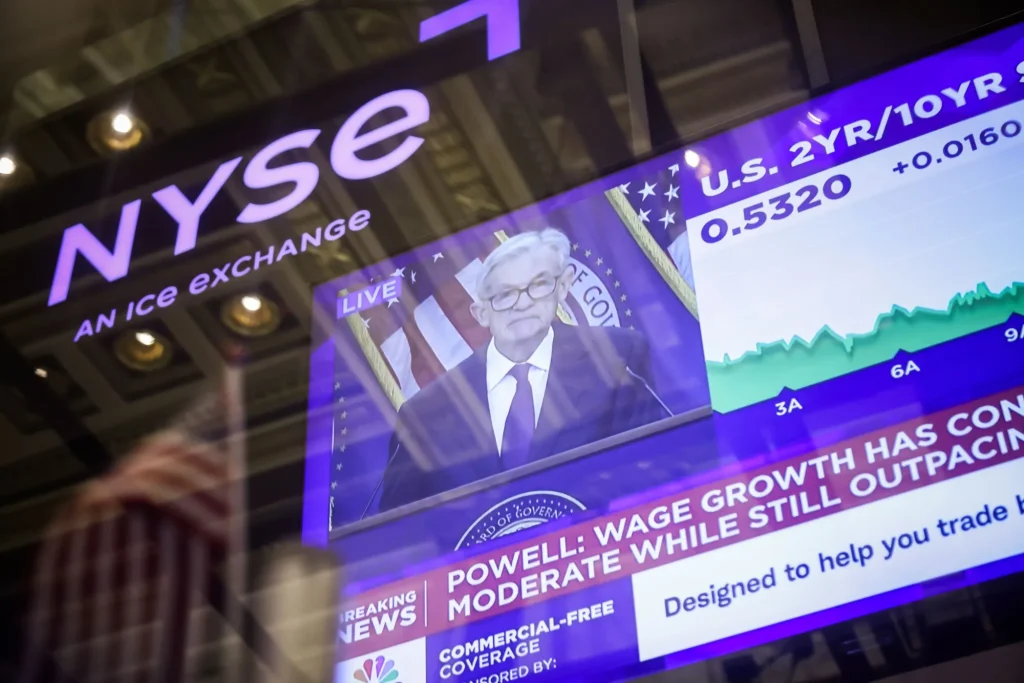
Wall Street stocks eased on Monday after a string of record highs, as traders appeared ready for a pause following a massive $16 trillion surge in the S&P 500 since April. Bond markets moved higher, supported by strong demand for a $58 billion Treasury sale.
The recent gains, largely fueled by artificial intelligence optimism, have started to raise concerns about overextension. Major tech companies led the pullback. Oracle Corp. dropped over 2.5 percent after its cloud margin report fell short of expectations, while Tesla Inc. slid more than four percent following the release of new models priced below $40,000.
Investor enthusiasm has reached levels that signal caution. Goldman Sachs reported last week that client bullishness was the highest since December. Barclays Plc’s sentiment tracker and a Bloomberg Intelligence measure both suggested elevated optimism bordering on exuberance.
Ulrike Hoffmann-Burchardi at UBS Global Wealth Management noted that consolidation is not surprising after such a strong run, but she emphasized that solid fundamentals still support the market. The S&P 500 closed near 6,715, reflecting a mixture of caution and ongoing confidence among investors.
Dell Technologies bucked the trend, climbing 3.5 percent after raising its estimates amid strong demand for AI solutions. At the same time, US 10-year Treasury yields fell three basis points to 4.13 percent, and the dollar gained slightly.
Federal Reserve remarks influenced sentiment. Governor Stephen Miran suggested that limited tariff impacts on inflation allow the Fed to continue easing policy. Meanwhile, Minneapolis Fed President Neel Kashkari cautioned that aggressive rate cuts could risk stoking inflation.
Citigroup analyst Chris Montagu warned that profit-taking risks have risen rapidly, especially for Nasdaq, which could limit further upside. Piper Sandler’s Craig Johnson, however, remained optimistic, noting that macroeconomic tailwinds continue to support the market. He recommended watching for subtle divergences in momentum and signs of stretched valuations.
Mark Newton at Fundstrat Global Advisors highlighted that while markets are overbought, this alone is not a reason to avoid US equities. Investors should remain attentive without becoming complacent. Similarly, Callie Cox at Ritholtz Wealth Management emphasized the need to follow earnings and economic data while noting that rising price-to-earnings ratios suggest a rebalancing may be prudent.
Some analysts caution that rapid double-digit gains in large tech stocks could indicate valuations are detached from fundamentals. AI-driven enthusiasm has drawn comparisons to the dot-com bubble of the late 1990s. Louis Navellier at Navellier & Associates noted the difference this time is that the companies involved are established and cash-rich. Nevertheless, setbacks in AI profitability could impact indexes in the short term.
Jamie Dimon, CEO of JPMorgan Chase & Co., reiterated the long-term potential of AI. The bank invests roughly $2 billion annually in AI development and achieves similar cost savings, highlighting both efficiency gains and strategic investment in technology.
BMO Capital Markets strategists Ian Lyngen and Vail Hartman noted that Tuesday’s moves reflected a normal pullback in tech, especially in cloud server stocks, and that the Treasury market remained stable throughout. The strategists emphasized that the decline did not signal a broader selloff but rather a pause after strong recent gains.
Corporate news continued to shape market trends. Dell Technologies raised growth projections for the next two years, citing AI product demand. IBM announced plans to integrate Anthropic AI into its software offerings. Salesforce confirmed it would not comply with a hacker ransom demand.
Other sectors faced headwinds. Gambling stocks, led by DraftKings Inc. and Flutter Entertainment Plc, fell after the NYSE revealed plans to invest up to $2 billion in Polymarket, a crypto-based betting platform. Ford Motor Co. encountered operational disruptions following a fire at a New York aluminum plant. Johnson & Johnson was ordered to pay $966 million in a lawsuit involving talcum powder claims.
In acquisitions, CoreWeave CEO Michael Intrator rejected calls to revise a $9 billion bid for Core Scientific Inc., citing investor feedback. Aviation and manufacturing news included delays at Ethiopian Airlines and weak luxury EV sales for Mercedes-Benz in China. Meanwhile, Banco Sabadell’s investors signaled opposition to a €17 billion BBVA takeover bid.
Investor focus is now on the balance between AI-driven growth optimism and potential overvaluation risks. With the S&P 500 having surged more than 35 percent from April lows, analysts caution that brief consolidation could provide healthier risk-reward setups. Market participants are weighing ongoing AI enthusiasm, macroeconomic tailwinds, and Federal Reserve policy guidance as they navigate the current trading environment.